|
|
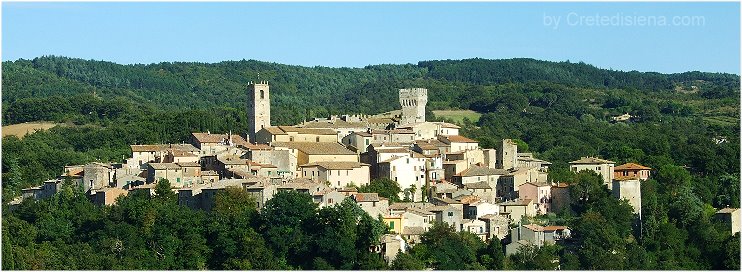
The town, with its typical medieval layout, is
situated on the western slopes of Monte Cetona, on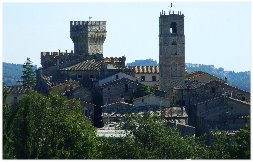 the Umbria and
Lazio border. Its land presents the “calanchi”, strange hills made of
sand and clay that make the landscape like the moon.
the Umbria and
Lazio border. Its land presents the “calanchi”, strange hills made of
sand and clay that make the landscape like the moon.
Since Etruscan
and Roman times, S. Casciano dei Bagni is famous for its thermal
water. In fact, the “ Pieve” (the church for baptism) had the name of
S. Mary”De Balneo”. In Roman times. The “Via Cassia” crossed this
territory, but in the Middle Age this old road became impassable and
marshy, so people used to run through the “Via Francigena”, the
international way. For this reason S. Casciano became famous in the
world. “Via Francigena”, the
international way. For this reason S. Casciano became famous in the
world.
In 995 Lord Ugo di Toscana gave the “Curtis de bagno” to
Saint Salvatore Abbey (Mount Amiata).
In 1412 the town became the
property of Siena and the world knew its famous thermal baths. In 1607
Lord Ferdinando 1st of Tuscany built its famous arcade and now 43
thermal springs (40°C.) flow nearby (5.5 million litres of water a
day: S. Casciano is the third thermal resort in Europe).
We can’t
forget the Gothic “Collegiata di S. Leonardo” and the church of “SS
Concezione”, with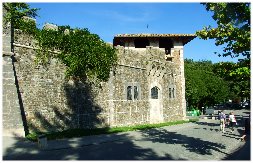 Pomarancio’s frescos. Pomarancio’s frescos.
Going up the hill from S.
Casciano dei Bagni we can visit the Castle of Fighine, which has
incomparable views over the Valdichiana. Siena and Orvieto fought
roughly for this castle. Nearby there is Palazzone, centre of wine
production, with its barocca church S. Maria Assunta.
In front of
Radicofani and Mount Amiata we meet Celle sul Rigo: from the top, the
great Medieval Tower is a perfect viewing point. The “Pieve di S.
Paolo”, the church of St. Giovanni and a well (XVII century) in the
middle of a small square are very interesting.
CHURCH OF “SANTA
MARIA DELLA COLONNA”
This church dates from the IV-V century and it
was built on the ruins of a pagan temple. For many years it was the
parish church, then it became a spiritual centre for people taking
thermal water treatment. It also became a “spedale”(old hospital) for
poor people. of a pagan temple. For many years it was the
parish church, then it became a spiritual centre for people taking
thermal water treatment. It also became a “spedale”(old hospital) for
poor people.
Inside there are many frescos from schools of Siena
and Orvieto.
CHURCH OF “CONCEZIONE”
In this church lived the
“Santissima Concezione Company’s” brothers. Inside there are some
interesting pomarancio’s frescos and the “Beato Pietro’s” tomb. Peter
was a hermit frozen to death on the steps of the church.
Tourist
Office:
Tel. 0578/58141
Spa:
San Casciano's spa:
Tel. 0578/58023
|
|