|
|

|
|
|
|
CHIUSI
( SIENA )
|
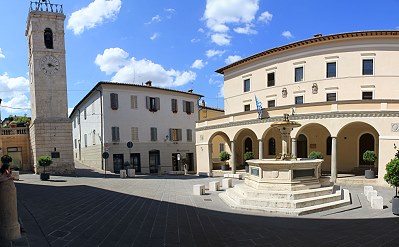 The territory of Chiusi was inhabited since eleventh century B.C.. The ancient Camars, then Clevsin, grown up about in the sixth century B.C. on a hill dominating the fertile Valdichiana; it was one of the most powerful town of the Etruscan Dodecapoli, so its “lucumone”Porsenna tried to occupy Rome in 520 B.C.. The decline of the town began in 391 B.C. with the siege of Galli Senoni, to which followed, in 351 B.C., the submission to Rome. Clusium, which in 89 B.C. became a Roman town, continued being anyhow a centre of great importance, favoured by Via Cassia ( Cassia Street ), that crossed it. After the aggression of Goti of Totila, in 543 A.D., Chiusi was occupied by Lombards near the end of sixth century A.D., that elected it to boundary Duchy with neighbouring territories of Byzantine Perugia. With the next Frankish rule the territory of Chiusi became a County. 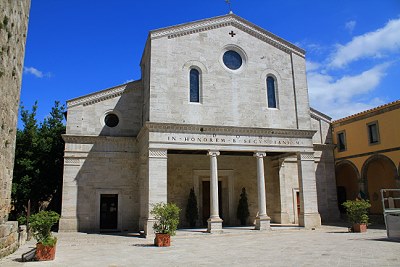 In the late eleventh century and in the early fourteenth century the town suffered a progressive decline, due to the increasing swamping of Valdichiana. So Chiusi became the object of endless contentions among Orvieto, Perugia and Siena. In 1415 the town was annexed to Sienese Republic. The National Archaeological Museum :It keeps very important finds of the Etruscan culture: “bucchero “ ceramics, the stone “fetida”,sculptures ( cippi, sphinxes ), sarcophagi, stone and terracotta cinerary urns. “ The Canopic vases “ are of great importance: they are cinerary vases typical of the area of Chiusi, characterized by lids in the shape of a human head, often placed on terracotta or bronze thrones. 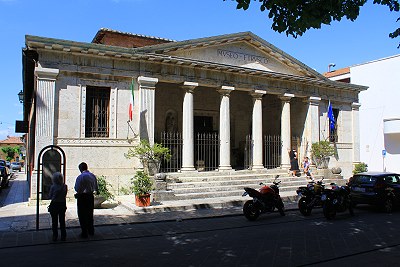 The Etruscan Necropolis: The large number of tombs scattered along the territory, unfortunately have suffered devastations, plunders and systematic spoliations in ancient times, above all in the late eighteenth century and the early nineteenth century. Among the very few hypogei accessible at present, we indicate the Tomb of the Lion ( Fifth century B.C.) and the Tomb of the Pilgrim ( Second Century B.C. ). The Museum of the Cathedral: Near the Roman, early Christian and early medieval archaeological ruins found in the Cathedral’s area, there are numerous liturgical fittings and eleventh and seventeenth centuries paintings. The 21 beautiful illuminated choirs are very important, they were painted in the second half of fifteenth century by Sano di Pietro, Venturino, Mercati, Liberale of Verona. The catacombs: Since the second century A.D. Christianity spread in Chiusi, as the Catacombs of Santa Mustiola and Caterina testify. The catacombs were used up to the fifth century A.D.; afterwards they were buried up to avoid their profanation. From the Porsenna’s labyrinth to the Tower of San Secondiano. 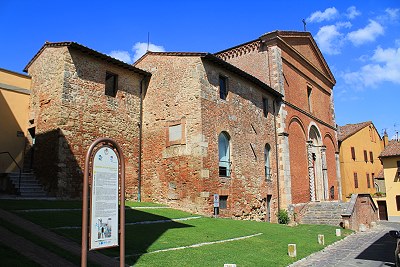 The underground passage which winds from the gardens of the Bishop’s Palace, through underground tunnels excavated during the Etruscan age to make the water drainage and water supply easier, reaches a monumental Roman tank and the adjoining thirteenth century bell-tower, near Secondiano’s Cathedral. From the Bell Tower you can admire a vast panorama including Valdichiana and the Lakes Chiusi, Montepulciano and Trasimeno. Lake Chiusi: The lake, residue of Valdichiana’s marsh, is a site of great importance for its flora and fauna 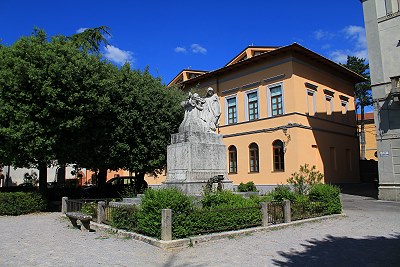 Tourist Information ASSOCIATION PROLOCO Chiusi ( Siena ) - via Porsenna - 53043 - Chiusi (SI) - Tel e Fax 0039 0578 227 667 - info@prolocochiusi.it National Archaeological Museum Address Via Porsenna, 93 53043 Chiusi (SI) Hours 09:00 to 20:00 (last admission 19.30) Entrance Fee € 4.00. Up to 18 years and more than 65 years free admission, 50% (€ 2.00) from 18 years to 25 years and the role of teachers in state schools (only European Community). Contact Tel 0578 20177, fax 0578 224452; e-mail: @ sbatos.museochiusi beniculturali.it The entrance ticket to the museum includes a visit to two fascinating Etruscan tombs, the Lion and that of the Pilgrim, the latter with a rich array of urns and sarcophagi still in place, the tomb of the Monkey, with a cycle of wall paintings, is open only on Tuesdays, Thursdays and Saturdays (11.00 and 16.00, from November to February 11.00 and 14.30), by reservation. The tombs are located about two miles from the museum along the road that leads to Lake Chiusi. The Museum also includes a major conservation laboratory visited on request. |
|
Fiere e sagre - Prodotti tipici - Turismo e Cultura
- Affittacamere - Dimore di campagna
cretedisiena.com Network
cretedisiena.com
-
cretedisiena.it
-
agriturismobagnovignoni.com -
agriturismopienza.com
-
visitmontepulciano.it 


cretedisiena.com Network
cretedisiena.com
-
cretedisiena.it
-
agriturismobagnovignoni.com -
agriturismopienza.com
-
visitmontepulciano.it
Per Informazioni

Cretedisiena.com - Via di Totona 12 53045 Montepulciano Siena - P IVA 010075105201