|
|
|
 |
|
|
|
|


|
Castiglione
d�Orcia, mentioned since 714, was owned by Aldobrandeschi, and
then it became a f In the centre of the square, which slopes, there is a beautiful travertine font of 1618. In front of it there is the Town Hall: a fresco of Sienese school representing the Madonna with her Baby and two Saints, coming from Rocca d�Orcia, is kept in it. The
walk inside Castiglione must include also the beautiful
Romanesque Church of Santa Maria Maddalena, which has been restored
recently. Its fa�ade dates from the thirteenth century, the apse is
one century older, and Once
they have been restored, they will form
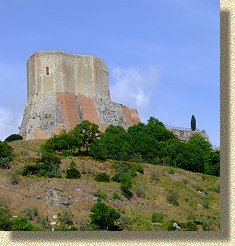
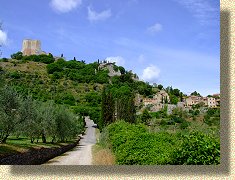
The view that you can admire from there, over Castiglione, Amiata and the Fortress of Tentennano, is beautiful. This striking fortalice; which seems impregnable, is the most exciting sight for the visitor of Castiglione. Rather than approach it by car, it�s better to reach it on foot from the town, enjoying the sight of the Fortress encircled by cypresses. Since ninth century it was owned by San Salvatore�s Abbey, and then in the half of 1100 it passed on to Tignosi�s family, Aldobrandeschi�s Vassals. In
1251 it was transferred to the Commune of Sien The fortress has been restored as from 1975 and it can be visited on Saturdays and on Holidays , all year round, and all summer days ( to visit it in different periods, pls. Apply directly to the Town Hall ). The interior is characterized by mighty ancient massive walls alternated with modern constructions ( staircases, windows, railings ) built as from 1989. The
bare halls and the view that you can admire from the terrace are very
striking. From the Fortress of Tentennano you can admire also a
beautiful view over Rocca d�Orcia,a village leaning against the rock
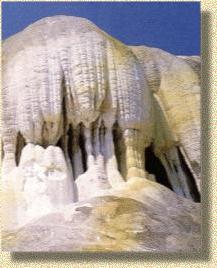
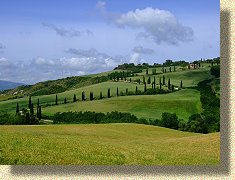
and built on a steep slope. If you reach it from the top, you w From Rocca d�Orcia a suggestive walk runs down to the exposed gravely river bed of Orcia Valley. You must go down following the asphalt road towards the national road 323, and there turn left following a downhill dirt road ( dead-end sign ), which descends between wood and fields and leads to Molino Farm. You can easily reach it by car. You must descend again following the cart road among the fields, which leads to an ancient mill encircled by vegetation, and to the picturesque course of the Orcia, at the entrance of its defiles. On the right there are the ruins of a travertine bridge, destroyed by a flood in 1929, and the ruins of a footbridge, built in place of it, but collapsed in its turn. The valley, with its river flowing in a rocky bed, is very suggestive; from there you can sight herons and kestrels and you can go for beautiful walks. Once you crossed the river, on a cement path, you can reach on the left the castle of Ripa d�Orcia and on the right Bagno Vignoni ( it takes little more than half an hour to cover each itinerary ). Taking the path on the left, marked by a sign, which starts from Molino Farm and goes through the left orographic bank of the defiles, you reach another marked path which goes up on the left, in Scarceta and Montelaccio�s scrub. If you reach Finocchietti Farm, you can return on the left, to Castiglione d�Orcia, completing in this way an itinerary which takes about three hours. During this walk you can admire the beautiful ilex wood and the panoramas over Ripa d�Orcia, a mighty castle, owned at first by Salimbeni and then by Siena Republic. Turned in a farm and today in a restaurant, it is one of the most striking fortresses of this region. You can reach it by car leaving Cassia Road near San Quirico and following a beautiful dirt road which skirts the Village of Vignoni. From the entrance of Ripa d�Orcia�s Fortress ( to visit it you must apply to the owners ), on the left a path rises in few metres to a spectacular natural balcony on Orcia and Amiata�s defiles. Up the town the territory of Castiglione d�Orcia is characterized by wide rises, partly cultivated and partly used as grazing lands; the road to Vivo and Amiata and the aqueduct of Siena run across them. Towards the valley, not far from Cassia Road, there are � San Filippo�s Hot Springs � ( I Bagni di San Filippo ), which deserves a visit. Here thermal waters gush out at 250/520�C. The village and San Filippo Benizi�s Monastery deserve a stop; the monastery is a cave turned into a chapel by the religious order of Serviti. But the most spectacular places are the big calcretes of the White Ditch ( Fosso Bianco ), where you can have a bath under the waterfall or in two natural basins ( one cold and one hot ). This area is one of the most photogenic of Amiata and It reminds, even if of smaller proportions, the fairy tale calcretes of Pammukale in Turkey and the Mammoth Hot Springs in Yellowstone Park, in America
|
|

cretedisiena.com Network
cretedisiena.com
-
cretedisiena.it
-
agriturismobagnovignoni.com -
agriturismopienza.com
-
visitmontepulciano.it
Per Informazioni

Cretedisiena.com - Via di Totona 12 53045 Montepulciano Siena - P IVA 010075105201